

Overview
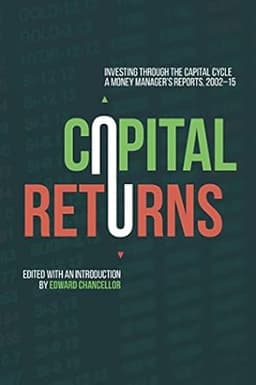
Capital Returns is not a conventional book. It is a collection of investor letters and research reports written by Marathon Asset Management and later edited by Edward Chancellor.
The central idea is simple enough to sound almost obvious: follow the capital.
When Marathon spoke with operators outside finance, many responded that the process described in these letters sounded like basic business sense. In many ways, it is. Yet markets have a habit of drowning out that kind of thinking with narrative, forecasting, and short-term performance pressure.
At the heart of the book sits the capital cycle. High returns attract capital. Low returns repel it. Over time, those flows reshape industries.
The challenge is not recognising the cycle in hindsight. It is understanding where you are within it while it is unfolding.
The Capital Cycle in Plain Terms
When returns in an industry are strong, capital flows in. Companies expand capacity. New entrants appear. Management teams grow confident. Investment budgets increase.
With a lag, supply catches up.
As capacity expands, pricing pressure builds. Returns begin to fall.
When returns deteriorate enough, the process reverses. Investment is cut. Marginal players exit. Assets are written down or consolidated. Capacity contracts.
With another lag, supply tightens and profitability recovers.
From a macro perspective, this resembles Schumpeter’s creative destruction. The boom encourages excess. The bust clears it away. Capital that was misallocated is written off. A new equilibrium eventually forms.
For an investor, that clearing process is not simply academic. It is often where opportunity begins.
The most attractive entry points tend to appear when supply is shrinking, investment has been slashed, and sentiment is pessimistic. The most dangerous points usually occur when capacity is expanding aggressively and optimism feels justified.
Linear Thinking in a Cyclical System
One of the sharper observations in Capital Returns is how often investors extrapolate.
When profits rise, forecasts extend the trend. When demand has been strong, models assume it remains strong.
In a cyclical system, that linear reasoning becomes fragile.
There is always a lag between capital spending and its impact on supply. A new factory, mine, airline fleet, or data centre cannot be built overnight. By the time the new capacity arrives, the demand assumptions that justified it may have shifted.
Supply is lumpy. It does not adjust smoothly, even if textbooks suggest it should.
More often than not, the cycle turns because supply overshoots quietly. Demand does not have to collapse for returns to fall. It only needs to disappoint relative to the capacity that has been built.
Focus on Supply, Not Demand
This is the book’s most distinctive contribution.
Most investors devote enormous energy to forecasting demand. They build models projecting unit growth five years forward. They debate total addressable markets and macro drivers.
Marathon suggests that supply may offer clearer signals.
Capital expenditure trends are reported. New capacity announcements are public. IPO pipelines are visible. Debt issuance can be tracked. Management commentary often reveals expansion plans in detail.
When an industry is enjoying high returns and companies are issuing equity, raising debt, and announcing ambitious expansion, that is usually not a favourable point in the cycle.
When investment budgets are cut, assets are written down, and weaker competitors begin to exit, conditions may be improving beneath the surface.
I remember watching both the 2017 ICO wave and the later DeFi and NFT booms with a kind of fascination. At the time it felt as though demand was insatiable. Every week there was a new token, a new protocol, a new promise. Prices rose quickly enough that supply did not seem to matter. Only later did it become obvious that the number of tokens had multiplied so dramatically that capital would have to disperse across an ever-widening field. Even if the technology progressed, the simple arithmetic of too much supply made broad appreciation unlikely. The returns had attracted more competition than the ecosystem could reasonably sustain.
Returns do not simply respond to demand. They respond to the balance between demand and supply, and supply often moves in larger, slower waves than investors expect.
Accounting Clues and Competitive Signals
The capital cycle leaves footprints.
Rapid asset growth often precedes disappointing returns. When capital expenditure relative to depreciation rises well above historical norms, it can signal that too much money is chasing past profitability. A widening gap between reported earnings and free cash flow may indicate aggressive reinvestment whose returns remain uncertain.
Industry concentration also matters. Tools such as the Herfindahl Index can provide insight into whether competition is intensifying or consolidating.
There are softer signals as well. A surge of IPOs in a fashionable sector. Secondary equity offerings at elevated valuations. Rising leverage. Grand headquarters projects. Confident management language.
These are not proof of a top. They are symptoms of capital flooding toward recent success.
Lately, reading about record levels of data centre capital expenditure in the AI space has felt familiar. The technology is impressive and the opportunity is real. But when multiple firms commit tens of billions at once, the supply side begins to move in waves. Incentives matter here as well. Founders, executives, and investors are rewarded for optimism. Soundbites about artificial general intelligence arriving imminently attract attention and capital. We have seen this dynamic before. Elon Musk has suggested full self driving was months away for years. Tweets and headlines can create urgency, but steel and concrete take time to earn returns. The important question is not whether AI will matter. It is whether capital is arriving faster than sustainable demand can absorb it.
The positive phase of the capital cycle rarely announces itself loudly. It often begins quietly, when investment is curtailed and capacity exits the system.
The Turn Feels Wrong
The most attractive point in the cycle is rarely comfortable.
It often coincides with collapsing profits, plant closures, management turnover, and bleak headlines. Analysts, focused on near-term earnings, struggle to model recovery. Investors, influenced by recent losses, hesitate to re-engage.
This is where long-term capital has an advantage.
Applying capital cycle analysis requires patience and a tolerance for looking early. Recovery in returns tends to lag the reduction in supply. It takes time for excess capacity to be absorbed and for pricing power to re-emerge.
But when competition diminishes and capital discipline returns, profitability can improve more persistently than the market expects.
Competition Is the Core
At its heart, Capital Returns is a study of competition.
Changes in the amount of capital employed within an industry alter competitive dynamics. More capital typically means more capacity, more rivalry, and lower returns. Less capital often means the opposite.
Understanding the supply side of an industry frequently reveals more about future profitability than a detailed demand forecast.
The key question is straightforward.
Is capital entering the industry or leaving it?
That flow shapes the competitive landscape, and over time it shapes returns.
Final Thoughts
Capital Returns reframes investing around capital allocation and industry structure.
It reminds us that markets are not driven solely by growth narratives or demand curves. They are shaped by supply, incentives, and the behaviour of managers responding to recent profitability.
High returns attract competition. Competition pressures returns. Low returns discourage investment. Reduced investment sets the stage for recovery.
Earlier in my investing journey, I was drawn almost entirely to narrative. In crypto especially, it often felt as though the story was the only thing that mattered. Later, moving toward traditional value investing, I swung in the opposite direction and tried to dismiss narrative altogether. Over time I have realised that neither extreme is sufficient. Stories attract capital. Capital reshapes supply. The capital cycle sits somewhere in the middle, translating enthusiasm into eventual competition.
The cycle is not dramatic in theory. It is mechanical.
In practice, it is often ignored.
In a market environment that rewards short-term storytelling, focusing on supply can feel unfashionable. Yet much of long-term investing success depends on recognising when capital has already done too much damage, or when it has finally withdrawn enough to allow returns to improve.
It is not the most glamorous way to think about markets... But over time, paying attention to where the money is flowing, and where it has stopped flowing, can prove more useful than trying to predict the next headline.