

Overview
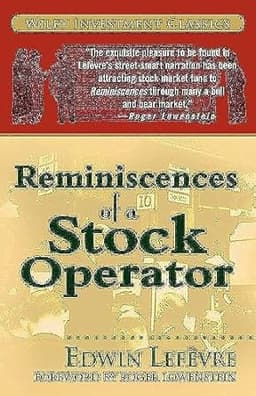
Reminiscences of a Stock Operator is framed as fiction, but it reads like field notes from the psychological front line of markets.
Edwin Lefèvre tells the story of Jesse Livermore - renamed Larry Livingston - tracing his rise, ruin, and repeated resurrection. It is a book about speculation, but more deeply, it is a book about temperament.
What makes it endure is not the tape-reading anecdotes or the bucket shops. It is the uncomfortable familiarity of the mistakes.
Markets change. Human nature does not.
The Market Is Never Wrong
One of the central lessons in the book is stark:
The market is never wrong - opinions often are.
That sentence is easy to quote and hard to live by.
Livermore learned, repeatedly, that being “right” about fundamentals is not enough. If price is not confirming your thesis, the market is telling you something - even if you do not yet understand what.
There is a humility embedded in that idea. The tape does not care about your reasoning, your cost basis, or your need to be vindicated.
I’ve felt that tension personally. You can build a valuation model that makes sense. You can outline a clear thesis. But if price action contradicts you for long enough, stubbornness turns from conviction into ego.
Livermore paid for that distinction several times.
Sitting Tight
Perhaps the most famous line in the book is this:
It never was my thinking that made the big money for me. It always was my sitting.
The insight is simple but counterintuitive.
Most traders focus on entry. Livermore came to see that the real money was made in the waiting - in allowing a correct position to mature without interference.
This requires a different kind of strength. Not the strength to act, but the strength to refrain.
He discovered that markets trend. And once a major move is underway, the temptation to take small profits can be more damaging than the fear of loss.
It reminds me of how easy it is to interrupt compounding. You get uncomfortable. You want to lock something in. You trade around the edges. The big move belongs to those who can tolerate boredom.
Being Right Too Early
One of the more painful themes in the book is the cost of being right too early.
Livermore often anticipated major moves correctly but acted before the market was ready. Timing is not an accessory to a thesis. It is part of the thesis.
He learned to wait for confirmation - for price to align with his view - rather than trying to impose his view on price.
This lesson resonates with a broader investing principle we’ve talked about before: the difference between analysis and execution. A sound macro view, or a correct valuation, does not automatically translate into profit. The market must agree, eventually, and you must survive until it does.
There is a difference between insight and tradeable opportunity.
The Enemy Is Within
If there is a villain in this story, it is not Wall Street. It is human nature.
Livermore battled hope, fear, greed, and the need to recover losses quickly. He overtraded. He increased size after wins. He tried to win back losses in a single stroke.
At one point he reflects:
A man must believe in himself and his judgment if he expects to make a living at this game.
But belief without discipline is dangerous. Confidence must be paired with risk control.
He eventually developed rules:
- Cut losses quickly.
- Add to winners, not losers.
- Trade in line with the primary trend.
- Avoid overexposure.
These rules sound obvious. They are violated daily.
The deeper insight is that markets magnify personality. If you are impulsive, the market will make you more so. If you are patient, it will test that patience repeatedly.
It becomes a mirror.
The Cost of Tips and Stories
Livermore repeatedly warns against tips, rumors, and persuasive narratives.
The temptation to outsource judgment is strong. It relieves responsibility. If you lose on a tip, you can blame the source.
But borrowed conviction collapses under pressure.
There is a line that captures this bluntly:
I have found that tips are not to be depended upon.
The simplicity is almost funny. Yet the underlying point is serious. Markets reward independent thinking, but independence is uncomfortable.
In modern terms, this applies just as much to financial media, Twitter threads, and confident podcast guests as it did to bucket shop whispers.
Noise scales with technology. Psychology does not improve with it.
Speculation as a Profession
What distinguishes Reminiscences from a moral tale is that Livermore does not dismiss speculation. He treats it as a craft.
He studies behavior. He observes patterns in how crowds respond to news. He notes that big operators accumulate quietly and distribute into strength. He watches how markets react to expected versus unexpected developments.
There is respect in that approach.
Speculation, done seriously, is not gambling. It is the disciplined management of uncertainty.
But it is unforgiving.
Livermore makes and loses fortunes multiple times. Each cycle reveals the same lesson: without strict risk control, the market will eventually extract payment.
Parallels With Long-Term Investing
Although the book centers on speculation, many principles translate directly to longer-term investing.
- Respect price.
- Avoid averaging down out of pride.
- Control position size.
- Do not let profits turn into losses through hesitation.
- Understand that crowd behavior drives extremes.
Where a value investor might speak of margin of safety, Livermore speaks of staying power. Both point to the same underlying necessity: survival.
You cannot compound if you are wiped out.
The Emotional Cost
What gives the book its depth is not the trades. It is the toll.
The isolation.
The pressure.
The cyclical nature of triumph and collapse.
Livermore’s story ends in tragedy. That shadow hangs over the narrative.
It is a reminder that markets can consume identity if you let them. If your self-worth fluctuates with your equity curve, stability becomes elusive.
That is a lesson I take seriously. The discipline required to succeed in markets must extend beyond capital. It must include boundaries.
Who Should Read It
This book works on multiple levels.
A new trader will see patterns that still unfold daily. An experienced investor will recognize emotional traps that never disappear, only change form.
It is not a technical manual. It is a psychological case study.
Read alongside more formal works on valuation or risk, it provides texture. It shows what happens when theory meets leverage, ego, and real money.
Final Thoughts
What stays with me most is not the big wins.
It is the repeated rediscovery that the hardest battle is internal.
The market does not need to conspire against you. Your impulses will do that work.
Sit tight when you are right.
Cut losses when you are wrong.
Wait for the market to confirm.
Guard your temperament more carefully than your predictions.
The arithmetic of speculation is straightforward.
The psychology is not.
That tension is what makes this book timeless.