

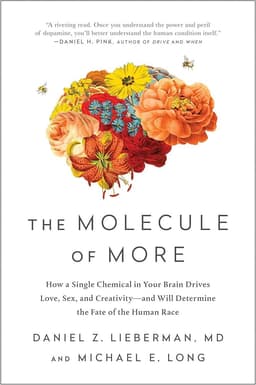
Overview
The Molecule of More is a book about dopamine, but it is really a book about the tension between the future and the present.
Lieberman and Long argue that dopamine is not the chemical of pleasure, as it is often described. It is the chemical of anticipation. It pulls us toward what might be. It fuels ambition, creativity, romantic longing, technological progress, addiction, and regret.
In three sentences:
- Dopamine gives us the ability to put forth effort. It creates desire and drives us toward a better future.
- Dopamine tells us what we want, not what we will like.
- We love novelty and surprise, but once something becomes familiar, the excitement fades and we begin scanning the horizon again.
That last point is uncomfortable. It suggests that much of what we call happiness is really pursuit.
Look Up, Look Down
One of the book’s most useful distinctions is spatial.
Look down.
Anything in your immediate vicinity, anything you can touch or control right now, belongs to what the authors call the “Here & Now” system. Oxytocin, serotonin, endorphins, endocannabinoids. These chemicals help us enjoy what is present. They anchor us in connection, warmth, and satisfaction.
Look up.
Anything in the distance, anything that requires time and effort to reach, belongs to dopamine. It is concerned with what is not yet here. It whispers: more.
This framing clarified something for me. I’ve often felt the strange dissatisfaction that comes after achieving a goal. You think the arrival will feel permanent. Instead, the mind moves on.
Passion rises when we dream of a world of possibility, and fades when we are confronted by reality.
The book argues that this is not a moral failing. It is a feature of the system.
Wanting Is Not Liking
One of the most important ideas in the book is the separation between wanting and liking.
The sensation of wanting is not a choice you make. It is a reaction to the things you encounter.
Dopamine generates wanting. It energizes pursuit. But it does not guarantee enjoyment.
You can crave the promotion, the purchase, the relationship, the drink. Once you get it, the spike fades. Sometimes quickly. Sometimes embarrassingly quickly.
Buyer's remorse makes more sense in this light. So does the restless feeling after success. The mind was built to chase, not to rest.
This helps explain addiction too. Dopamine pushes behavior toward anticipation and novelty. The “hit” is less about pleasure than about the promise of it. Over time, the wanting can intensify even as the liking diminishes.
That asymmetry is dangerous.
Desire and Control
The authors distinguish between two dopamine pathways.
The mesolimbic system drives desire. It is the raw “give me more.” It chases reward, novelty, possibility.
The mesocortical system supports control. It allows planning, delayed gratification, abstract reasoning. It is what lets us imagine a future and work toward it methodically rather than impulsively.
When desire outruns control, we get compulsive behavior. When control suppresses desire entirely, we lose energy and creativity.
A balanced life requires both. Enough dopamine to dream. Enough control to execute without self-destruction.
For a biological organism, the most important goal related to the future is simple: be alive when it comes. Control exists to protect that.
Love, Glamour, and the Illusion of More
The book spends time on romantic attraction, and the pattern is familiar.
Early love is saturated with dopamine. Mystery, possibility, idealization. As Virginia Postrel wrote:
Glamour is a beautiful illusion — it depends on a special combination of mystery and grace. Too much information breaks the spell.
Once familiarity sets in, dopamine quiets. What remains are the Here & Now chemicals. Attachment, comfort, companionship.
This explains why long-term relationships require intention. Dopamine chases novelty. Stability requires something else.
The same applies to careers, cities, even ideas. The dream often feels brighter than the reality. That does not make the reality worthless. It simply means the brain has shifted systems.
To travel hopefully is better than to arrive is the motto of the dopamine enthusiast.
There is truth in that line. There is also risk.
Progress and Madness
Dopamine is responsible for much of human advancement. It fuels invention, exploration, entrepreneurship. Without it, we would not have left the cave.
But it also fuels extremism and obsession. The same chemical that drives scientific breakthroughs can drive destructive fixation.
The book’s strength is in refusing to moralize. Dopamine is not good or bad. It is directional.
If pointed toward long-term goals with strong mesocortical control, it builds. If allowed to run unrestrained, it can destabilize.
I found myself reflecting on my own patterns while reading. Ambition feels virtuous. But ambition untethered from enjoyment can hollow things out. You achieve, then chase again. You build, then escalate.
It becomes easy to confuse motion with meaning.
Addiction and Recovery
The framework around addiction is sobering.
Drugs hijack dopamine. They create artificial spikes of anticipation and reinforcement. Over time, natural rewards lose their intensity. The baseline shifts.
Recovery, then, is not just abstinence. It is retraining the system. Reconnecting dopamine to effort, to purpose, to gradual achievement rather than instant reward.
This has implications far beyond substances. Social media, financial speculation, constant news consumption. All of it feeds the wanting circuit.
It is not hard to see how a dopamine-dominant culture can struggle with contentment.
Personal Reflection
I discovered this book through an Andrew Huberman podcast. I expected neuroscience. I did not expect it to feel so personal.
It reframed how I think about drive.
There is a part of me that is always looking forward. The next milestone. The next improvement. The next edge. That part is useful. It has built things.
But it also explains the subtle restlessness that can creep in when things are going well.
The book does not tell you to suppress dopamine. It suggests understanding it. To notice when you are in a wanting loop. To consciously engage the Here & Now system. To cultivate satisfaction alongside ambition.
That balance feels harder than either extreme.
Who Should Read It
Anyone interested in motivation, addiction, ambition, or relationships will find something here.
For investors in particular, it provides a lens on risk-taking and speculative behavior. The thrill of a trade is often dopamine. The satisfaction of a long-term compounding strategy is more often serotonin and patience.
Understanding that distinction can change behavior.
Final Thoughts
The Molecule of More is not just about chemistry. It is about the structure of human longing.
Dopamine pulls us forward. It imagines futures. It creates desire. It is responsible for art, science, romance, and relapse.
The Here & Now chemicals anchor us. They let us enjoy what we have already built.
A life dominated by dopamine feels exciting but unstable. A life without it feels safe but stagnant.
The art is in learning when to look up, and when to look down.