

Overview
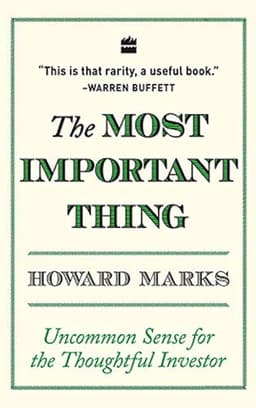
Howard Marks’ The Most Important Thing feels like a long conversation with someone who has lived through enough market cycles that very little surprises him anymore.
Each chapter is framed as “the most important thing.” Not because it is the only thing that matters, but because investing forces trade-offs. You cannot optimise for growth, safety, liquidity, and timing all at once. At any moment, one constraint dominates. Marks is interested in identifying which one it is.
He writes from the perspective of credit markets, but the principles travel easily. Risk, cycles, psychology, valuation, humility - these are not niche topics. They are permanent features of markets.
If there is a thread running through the book, it is this: superior results rarely come from superior forecasts. They come from superior thinking.
Second-Level Thinking
Marks’ distinction between first-level and second-level thinking is one of the book’s most enduring ideas.
First-level thinking is straightforward. The economy is strong, so stocks should do well. Earnings are rising, so the company looks attractive. The reasoning is not foolish. It is simply incomplete.
Second-level thinking asks a harder question. What is already priced in?
If the economy is strong and everyone knows it, how much optimism is embedded in today’s valuation? What assumptions must hold for the current price to be justified? What would have to go right from here?
The objective is not contrarianism for its own sake. It is recognising that markets reflect consensus expectations. To outperform, you have to diverge from that consensus in a way that turns out to be correct.
Being right about fundamentals is not enough. You have to be right relative to what others believe. That is a higher bar than it first appears.
Risk Is the Central Variable
Marks is careful with the word risk. He does not equate it with volatility. He defines it as the possibility of permanent loss.
That distinction reshapes the conversation.
Volatility can be uncomfortable. Permanent loss interrupts compounding. One affects emotions. The other affects outcomes.
This perspective echoes the older value investing tradition:
The fault, dear investor, is not in our stars - and not in our stocks - but in ourselves.
Risk often emerges from behaviour. Overconfidence, leverage, herd pressure, and impatience can turn a reasonable investment into a fragile one. The same asset held with different levels of leverage and different expectations can represent very different risk profiles.
Marks returns repeatedly to a defensive posture. Good investing begins with avoiding catastrophe. You do not need to avoid every mistake. You need to avoid the kind that remove you from the game.
Cycles and the Pendulum
One of Marks’ most useful mental models is the pendulum.
Markets swing between optimism and pessimism, between risk tolerance and risk aversion, between greed and fear. The timing of these swings is unpredictable, but their existence is not.
Rule number one: most things will prove to be cyclical.
Rule number two: some of the greatest opportunities for gain and loss come when other people forget rule number one.
At extremes, investors stop demanding adequate compensation for risk. In euphoric markets, caution feels unnecessary. In panics, prudence feels naive.
Marks does not claim to forecast turning points precisely. Instead, he advocates calibrating behaviour to conditions. When risk is underpriced, lean toward caution. When fear dominates and assets are being sold indiscriminately, examine whether price has detached from value.
The skill lies less in predicting the next move and more in recognising where we stand in the cycle.
Price, Value, and Expectations
Marks returns frequently to the relationship between price and value.
Investing is not about buying good assets. It is about buying them well. A strong business can be a poor investment if purchased at an excessive price. A mediocre business can produce respectable returns if bought at a deep discount.
That idea is familiar. Marks adds a psychological layer.
Investing is a popularity contest, and the most dangerous thing is to buy something at the peak of its popularity.
When enthusiasm is universal, expectations are already elevated. Future buyers become scarce. When pessimism is widespread, expectations are depressed, and even modest outcomes can surprise positively.
The asymmetry often lies in sentiment as much as in spreadsheets. Understanding intrinsic value is necessary. Understanding what others expect is just as important.
Preparation Over Prediction
Marks is explicit about the limits of forecasting.
Interest rates, GDP growth, and short-term market moves are extraordinarily difficult to predict with consistency. Apparent forecasters often benefit from luck, selective memory, or short sample periods.
This is not an argument for disengagement. It is an argument for preparation.
You can't predict. You can prepare.
Preparation means building portfolios that can survive a range of outcomes. It means demanding a margin of safety. It means resisting the temptation to project recent trends indefinitely into the future.
Marks appears less interested in being right about the next year than in remaining resilient across decades.
Temperament and Independence
Underneath the technical discussion sits a psychological one.
Markets are social systems. They amplify emotion. They reward conformity in the short run and test it in the long run. To navigate that environment, you have to maintain a degree of independence.
Marks does not romanticise contrarianism. Acting differently from the crowd can be uncomfortable, especially when the crowd appears to be prospering. But exceptional performance requires positions that differ from consensus at some point.
That difference requires emotional steadiness. Risk awareness, price discipline, and second-level thinking all collapse if temperament fails under pressure.
Frameworks are only as durable as the person applying them.
Who Should Read It
The Most Important Thing functions less as a manual and more as a calibration tool.
A newer investor gains a vocabulary for thinking about expectations and risk. A more experienced investor may find that it sharpens instincts already shaped by experience.
Its power lies not in a single breakthrough idea, but in the repetition of core principles from multiple angles. By the end, you are not left with a formula. You are left with a clearer sense of how markets behave and how you should behave within them.
Final Thoughts
What makes the book endure is its realism.
Markets will cycle. Optimism will overshoot. Fear will overshoot in the opposite direction. Risk will be mispriced at both extremes.
The investor’s task is not to eliminate uncertainty. It is to navigate it with discipline.
Marks’ framework quietly reinforces a theme that appears across much of serious investing literature. Outperformance does not usually come from brilliance alone. It comes from clearer thinking under common pressures and from avoiding the kinds of errors that compound negatively.
Second-level thinking, respect for risk, awareness of cycles, humility about forecasting - none of these feel dramatic in isolation. Over time, applied consistently, they form a durable foundation.
That, in Marks’ telling, is the most important thing.