

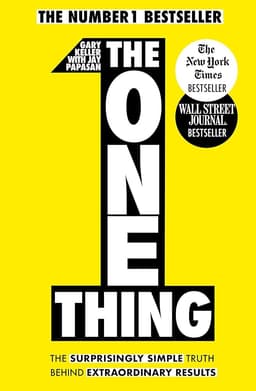
Overview
The ONE Thing is a simple book with a demanding message.
It argues that extraordinary results do not come from doing more. They come from doing less, but better. From narrowing your focus until the noise falls away and what matters becomes obvious.
The central question is almost disarmingly straightforward:
“What’s the ONE thing you can do such that by doing it everything else will be easier or unnecessary?”
It sounds like a productivity trick. It is not. It is a philosophy of attention.
This is one of my favourite books because it strips away the comforting lie that we can progress meaningfully in multiple directions at once. It insists that you choose.
Singleness of Purpose
The book opens with an attack on multitasking.
Most modern research suggests that multitasking is simply task-switching. You are not doing two things at once. You are splitting cognitive resources between them, and paying a cost each time you shift.
You cannot drive and hold a complex conversation with the same clarity as you could do either on their own, no matter how much you would like to believe otherwise.
As the authors put it, multitasking is merely the opportunity to screw up more than one thing at a time.
That line made me laugh the first time I read it. It also felt uncomfortably accurate.
When I look at my own worst days, they tend to be scattered days. Tabs open. Notifications buzzing. A vague sense of progress without any meaningful movement.
Singleness of purpose feels slower at first. Then it compounds.
Everything Does Not Matter Equally
One of the book’s most useful refrains is this:
Everything does not matter equally.
As children, our routines are dictated for us. Breakfast, school, dinner, bed. As adults, discretion replaces structure. With discretion comes choice. With choice comes responsibility.
Most people respond by staying busy. They say yes to too many things. They try to maintain optionality everywhere. The result is a kind of permanent busyness that looks productive but rarely produces anything exceptional.
Saying yes broadly is often another way of saying no to your most important work.
Achievers, the authors argue, operate differently. They are selective. They protect their time. They understand that focusing on one priority necessarily means neglecting others.
When you focus, it is like shining a spotlight. The edges dim. That is not a flaw. That is the point.
The 80/20 Rule in Practice
The book leans heavily on the Pareto principle. A minority of inputs drives the majority of outputs.
You see this everywhere.
A small number of companies drive most of the long-term performance of the S&P 500.
You wear a handful of clothes most of the time.
In the gym, a few compound lifts account for most of your strength gains.
The insight is not new. The application is what matters.
If a minority of actions drives the majority of results, then time allocation should not be equal. The most important activity deserves disproportionate attention.
That is uncomfortable. It forces trade-offs. It exposes distractions for what they are.
The Focusing Question
At the heart of the book is the “Focusing Question.”
Big picture:
What is my ONE thing?
Small picture:
What is my ONE thing right now?
The structure is recursive. Start with a long-term goal. Work backward. If your goal is to be in a certain place by year-end, where would you need to be by the end of the quarter? The month? The week? Today?
Eventually, you land on a single action.
The discipline lies in attacking the current bottleneck relentlessly. Not everything. The bottleneck.
It is simple. It is also rare.
I have found that even asking the question changes the tone of the day. It shifts you from reactive mode to deliberate mode. You stop asking, “What should I do next?” and start asking, “What matters most?”
Habits and the Sprint to Automaticity
Another idea that stayed with me is the reframing of discipline.
Success is actually a short race – a sprint fueled by discipline just long enough for habit to kick in and take over.
The authors argue that we overestimate how long things will feel difficult. When you repeat a behavior consistently, it becomes automatic. It moves to a different part of the brain. It stops requiring the same level of conscious effort.
This is hopeful.
Starting is hard. Continuing for a few weeks is harder. But once the habit forms, the effort drops.
The key is not to overhaul your life overnight. It is to pick one meaningful habit and apply just enough discipline to install it. Then move on to the next.
Over time, you become a person shaped by a small set of powerful routines.
The Myth of Balance
One of the more provocative claims in the book is that “work-life balance” as commonly framed is misleading.
The argument is not that personal life does not matter. It is that extraordinary results require extraordinary focus. Time spent deeply on one thing necessarily means time not spent elsewhere.
If you think of balance as permanently staying in the middle, you will avoid extremes. And the authors argue that the magic happens at the extremes.
There is tension here.
In your personal life, you do not want to abandon relationships in pursuit of productivity. In your professional life, however, you cannot do everything. Some things must be left undone.
The idea is not to neglect life. It is to recognize that seasons exist. At times, one area requires disproportionate attention.
That framing feels more honest than the fantasy of perfectly equal allocation.
Willpower and Pre-Commitment
The book also challenges the idea that willpower is reliable.
We like to imagine that our future self will be more disciplined than our present self. The problem is that when the future arrives, it is once again today.
Pre-commitment is the solution. Set up your environment so that the right behavior is easier than the wrong one.
The Homer analogy from The Odyssey is a good one. Strap yourself to the mast before you hear the sirens.
In modern terms: put your alarm clock across the room. Block distracting websites. Schedule deep work in advance. Remove friction from the habit you want to build.
You are not relying on willpower. You are designing around its limits.
Time Blocking
If disproportionate results come from one activity, then that activity deserves protected time.
The authors recommend time blocking early in the day, before reactive demands take over. In some cases, up to four hours dedicated to the most important task.
There is also a longer cadence: set aside weekly time to review monthly and annual goals.
This is less about scheduling and more about respect. If something truly matters, it should have a place in your calendar.
Otherwise, it is just an intention.
Final Thoughts
The ONE Thing is not complicated.
It asks you to stop pretending that everything deserves equal attention. It asks you to choose. It asks you to accept that extraordinary outcomes require disproportionate commitment.
It also offers something reassuring.
Clarity reduces complexity.
When you identify your ONE thing, the mental clutter shrinks. Decisions become easier. You know what to say no to.
The question is not whether you can do many things.
It is whether you are willing to do the most important thing long enough for it to matter.