

Overview
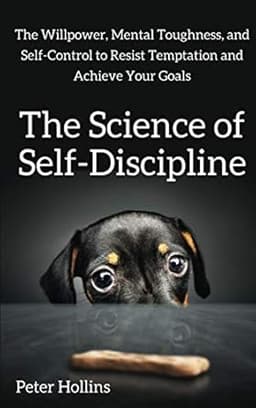
Peter Hollins’ The Science of Self-Discipline is not dense or academic. It is short, direct, and practical.
Its message is uncomfortable but clarifying:
Your current life is the result of your past thoughts and actions.
If you want more - more strength, more income, more clarity, more freedom - you have to start thinking and acting beyond what you previously accepted as normal.
Self-discipline is not glamorous. It is repetitive. It is often boring. And it is uncomfortable by design.
The book does not promise to make it easy. It shows you how to make it possible.
The 40 Percent Rule
One idea that stands out is the “40% Rule,” attributed to Navy SEAL training.
When you think you are done, when you feel you have reached your limit, you are often only at about 40%. You have far more left than your mind is telling you.
Whether the percentage is exact is beside the point.
The brain is protective. It signals discomfort early. Fatigue. Hunger. Boredom. Doubt. The moment something feels hard, it suggests retreat.
Self-discipline begins when you stop treating those signals as commands.
It is not that you ignore your limits recklessly. It is that you question whether the limit is real or simply emotional resistance.
The 10-Minute Rule
One of the most practical tools in the book is the 10-minute rule.
If you crave something - a cigarette, junk food, scrolling, quitting a workout - wait ten minutes.
Remove the “immediate” from immediate gratification.
Most urges are waves. They rise. They peak. They fall. By delaying action, you create distance between impulse and behavior.
You can also reverse the rule.
If you feel like quitting something productive, commit to ten more minutes. Just ten.
Often, the resistance dissolves once you are moving again.
It is a small circuit breaker. Small circuit breakers are powerful.
Rationalization Is the Real Enemy
Hollins makes a subtle but important point: the smarter you are, the better you are at rationalizing.
We can construct elegant arguments for weak behavior.
“I’ve had a long day.”
“One won’t hurt.”
“I’ll start properly tomorrow.”
The mind excels at building a case for comfort.
Self-discipline requires noticing the story without automatically believing it.
That is where self-awareness comes in.
Urge Surfing
Rather than fighting urges aggressively, Hollins suggests observing them.
This is sometimes called “urge surfing.”
Instead of saying, “I want a cigarette,” you reframe it as, “I am experiencing the urge to smoke.”
It sounds subtle. It changes everything.
You are no longer the urge. You are the observer of the urge.
This separation reduces its power. The sensation becomes something to watch rather than something to obey.
I’ve found this particularly useful. When you stop treating an impulse as your identity, it loses some urgency.
Discipline Is Uncomfortable
One of the more honest points in the book is that discipline does not become comfortable through knowledge alone.
You can read about delayed gratification. You can understand dopamine. You can intellectually value perseverance.
None of that removes discomfort.
Self-discipline is uncomfortable by nature. The skill is not eliminating discomfort. It is learning to tolerate it.
Huberman often talks about attaching reward to effort itself. Instead of focusing on the outcome, focus on the act of showing up.
If you can derive satisfaction from exertion, from the process, you gain stability. Outcomes fluctuate. Effort is controllable.
Design the Environment
Willpower is fragile. Environment is powerful.
Hollins emphasizes structuring your surroundings to preserve discipline for when you most need it.
Clear your desk.
Declutter your digital desktop.
Turn notifications off.
Leave your phone face down.
A chaotic environment drains cognitive energy. Order reduces friction.
I have noticed that even small acts of tidying can change the tone of a work session. A clear space invites focus.
Minimalism, in this sense, is not aesthetic. It is strategic.
Be Careful Who You Emulate
We absorb habits from the people around us.
If your peer group normalizes distraction, indulgence, or mediocrity, you will feel friction trying to operate differently.
If your environment normalizes effort and standards, discipline feels less lonely.
Others influence what we do, how we think, and who we become.
This is rarely acknowledged directly, but it is obvious in practice.
Don’t Announce Everything
Hollins warns against broadcasting goals prematurely.
Research suggests that telling others about your ambitions can create a premature sense of completeness. You receive social validation before doing the work.
It feels like progress. It is not.
There is nuance here. Accountability can help. But be careful not to substitute praise for performance.
The Future Self Is Not a Stranger
A powerful framing in the book is the idea that your future self is not a different person.
They are you.
When you skip effort today, someone absorbs the cost. That someone is your future self.
Tools like the 10-10-10 rule make this tangible:
How will I feel in 10 minutes?
10 hours?
10 days?
This stretches your perspective. It pulls you out of the narrow present moment and into a longer arc.
Discipline often emerges from connection to that longer arc.
Inject Small Discomforts
Hollins suggests deliberately practicing small acts of discomfort.
Turn the shower cold.
Order something unfamiliar.
Choose the harder option occasionally.
The goal is not self-punishment. It is building a default mode of perseverance.
The time you need discipline most is when it is most fleeting - when you are tired, hungry, irritated.
Training discomfort in low-stakes environments strengthens you for higher-stakes ones.
Habit Formation
On average, research suggests it takes about 66 days for a daily action to become automatic, though the range is wide.
In the beginning, effort feels heavy. Over time, it becomes second nature.
This is hopeful.
Start small. Choose one manageable behavior. Commit to it without negotiating with your emotions.
A disciplined life is not built in a dramatic moment. It is built through recurring small choices.
Final Thoughts
The Science of Self-Discipline does not romanticize grit.
It acknowledges rationalization. Fatigue. Impulse. The pull of comfort.
It also insists that you are capable of more than your immediate feelings suggest.
Self-discipline is not a single heroic act. It is a pattern.
Each time you choose effort over ease, you reinforce an identity.
Each time you delay gratification, you strengthen the bridge between present and future.
You do not control outcomes completely. You do control your effort.
And over time, effort compounds.